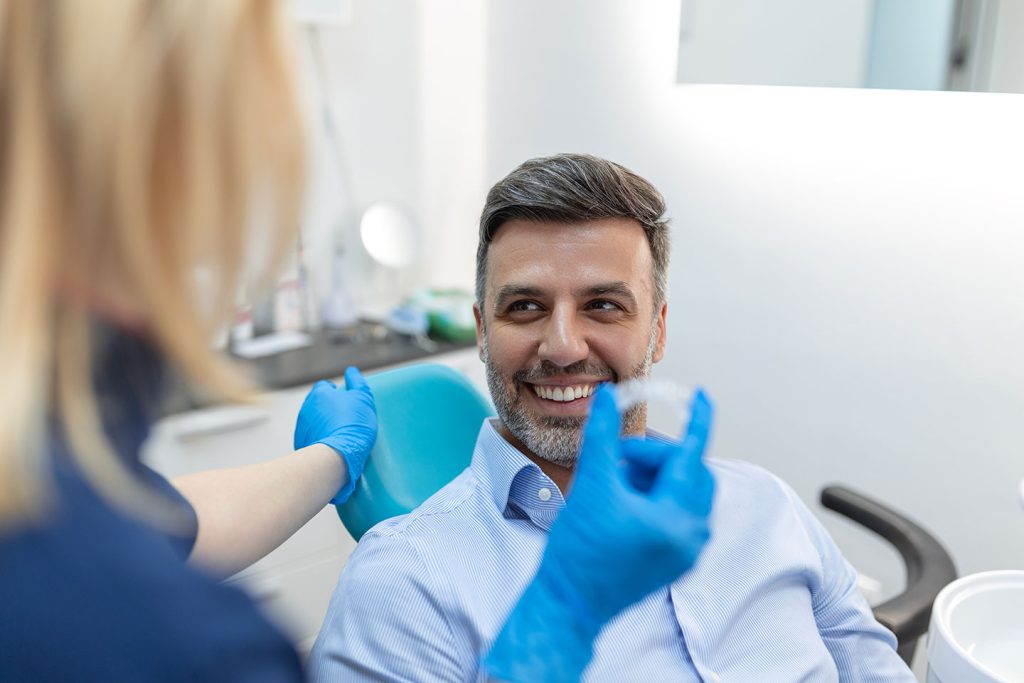
A lot of adults carry around a version of the same thought: they wish they had done something about their teeth when they were younger. Maybe orthodontics wasn’t an option growing up. Maybe they had braces as a teenager and their teeth shifted over the years. Maybe they’ve just never quite loved their smile but assumed that fixing it was something people do in their teens, not in their thirties, forties, or beyond.
That assumption is worth revisiting. Adult orthodontic treatment is more common than most people realize, and Invisalign has played a big part in that shift. If the idea of straightening your teeth has crossed your mind more than once, here’s what’s actually worth knowing.
Adults Are Getting Orthodontic Treatment More Than Ever
There’s a reason this conversation comes up so often in our office. Roughly one in three orthodontic patients today is an adult, and that number has been climbing steadily. Part of that is awareness, and part of it is the availability of clear aligner options that fit more naturally into an adult life than traditional metal braces do.
The desire for a straighter smile doesn’t expire at eighteen. Neither does the ability to achieve one. Teeth can be moved at any age, as long as the supporting bone and gum tissue are healthy. That’s really the key factor, not the number on your birthday cake.
Why Adults Often Prefer Invisalign
For adults considering orthodontic treatment, the most common concern isn’t the outcome. It’s the process. The idea of going through years of visible metal brackets in a professional setting, or at social events, or in photos, is enough to make a lot of people quietly set the idea aside and move on.
Invisalign addresses that concern pretty directly. The aligners are clear, custom-fitted to your teeth, and remarkably easy to overlook. Most people won’t notice you’re wearing them at all. For adults who spend time in meetings, in front of clients, or simply value not announcing their dental treatment to everyone around them, that matters.
The removability is another thing adults tend to appreciate in a way that teenagers sometimes don’t. You take the aligners out to eat, which means no restrictions on what you can and can’t have. You brush and floss exactly as you normally would. There’s no navigating around brackets or wires, and no carrying a special kit everywhere you go. The treatment works around your life rather than the other way around.
What the Process Actually Looks Like
If you’ve never looked into Invisalign, the process is more straightforward than many people expect. It starts with a detailed scan of your teeth, which is used to create a precise 3D model of your mouth. From there, a customized treatment plan is developed, and your aligners are made to spec before treatment even begins.
Each set of aligners is worn for about two weeks before moving on to the next set in the series. The aligners apply gentle, consistent pressure that gradually shifts your teeth toward the planned final position. Treatment length varies depending on what needs to be corrected, but it typically runs somewhere between eight and eighteen months. Cases involving mild crowding or spacing issues can come in on the shorter end. More complex corrections take longer.
One of the things patients often mention afterward is that the office visits were less frequent than they expected. Unlike traditional braces, which require regular adjustments, Invisalign appointments are mainly about checking progress and providing the next sets of aligners. For busy adults, that’s a meaningful difference.
What Invisalign Can and Can’t Do
Clear aligners have come a long way since they were first introduced, and they can address a wider range of issues than most people assume. Crowding, spacing, overbites, underbites, crossbites, and open bites are all within the scope of what Invisalign can treat. The limiting factor is the severity of the case, not the type of issue.
There are situations where traditional braces remain the better tool, particularly for more complex bite corrections. If that’s the case for you, we’ll tell you honestly rather than pushing you toward a solution that isn’t the right fit. The goal is always the best outcome for your specific situation.
A Note on Insurance and Cost
Many dental insurance plans that include an orthodontic benefit will cover Invisalign, at least partially, in the same way they would cover traditional braces. It’s worth checking your specific plan before assuming it isn’t covered. Our team can help you understand what your insurance may contribute and what to expect out of pocket.
The Right Time Is Usually Sooner Than You Think
Most adults who go through Invisalign say the same thing when it’s done: they wish they had done it sooner. The process is less disruptive than they anticipated. The results are real. And the version of their smile they’d been quietly hoping for turned out to be genuinely achievable.
If you’ve been sitting on this idea for a while, it’s worth at least having the conversation. We’re happy to take a look at your teeth, talk through whether you’d be a good candidate, and give you an honest picture of what treatment would involve for you specifically. There’s no pressure and no commitment in asking. Give us a call or stop by and we’ll go from there.